

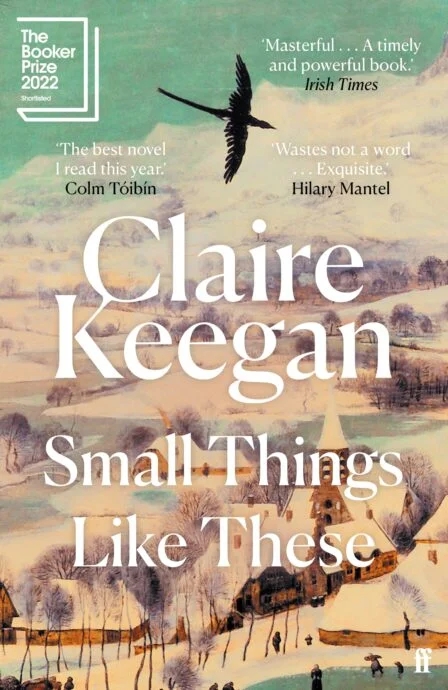
Title: Small Things Like These
Author: Claire Keegan
First Publication Date: November 30, 2021
Genre: Historical Fiction, Literary Fiction
Rating: ☕☕☕☕︎ (3.5/5)
Content Warnings: highlight to view {depiction of physical and emotional abuse, forced institutionalization, religious bigotry}
BLURB
It is 1985, in an Irish town. During the weeks leading up to Christmas, Bill Furlong, a coal and timber merchant, faces into his busiest season. As he does the rounds, he feels the past rising up to meet him – and encounters the complicit silences of a people controlled by the Church. (via Goodreads)
THOUGHTS
So many things had a way of looking finer, when they were not so close.
Claire Keegan’s Small Things Like These is a novella that centred on Bill Furlong, a coal merchant in a rural Irish town in the 1980s, amidst a moral and social dilemma. Told in a little over 100+ pages, this story surely packed a punch and told a story and heavy topic in a striking way.
Despite having a lovely family in the present, Bill’s life hasn’t been easy. With a single mother and an unknown father, his life was peppered by acts of kindness that allowed him and his mother a decent life in an otherwise conservative religious town (where having a child out of wedlock is considered a sin and frowned upon). While it might seem irrelevant at first, I think this crucial part of his life shaped him into who he is as an adult and ultimately lead to his actions in the final part of this story.
The quiet ease into the Furlong’s pivotal decision was deliciously written (and that extra .5 was mostly because of that). This book is dedicated to all women and children forced into the Magdalen asylums in Ireland. It’s of historical significance, of importance to acknowledge the events of this scandal – but I think Claire Keegan also did a brilliant job of giving an effective depiction and exposition on how a community can tolerate such horrible open secrets for a long time (‘If you want to get on in life, there’s things you have to ignore, so you can keep on.‘). When you are so used to a life of hardship, you won’t have the capacity or even the energy to deviate from norm or better yet care about anything else than your daily survival. Maybe this is one of the reasons for this tolerance in communities like this. That’s why it is an act of pure bravery to go against the grain.
Quiet, casual heroism and what it means to uphold your values: I think these are really the main takeaways from this short offering. And I think this quote perfectly sums it up:
‘As they carried on along and met more people Furlong did and did not know, he found himself asking was there any point in being alive without helping one another? Was it possible to carry on along through all the years, the decades, through an entire life, without once being brave enough to go against what was there and yet call yourself a Christian, and face yourself in the mirror?‘
This is a quiet book, unsettling in some aspects of it. And though I am usually a fan of such books, believe me, I was also surprised to give this a 3ish-star rating given how many readers have raved about it and have given it 4 to 5 stars. Though I appreciate the atmospheric element of it, something felt detached and I wasn’t really feeling it the most part. I know this is supposed to be a short story but I felt like it was abruptly cut short. Though there was emotional payoff by the end, but given how abruptly it ended, I was left wanting… more. On a positive note, it really piqued my interest so that’s why there was some disappointment when it ended.
The Magdalene LauNdries
The Magdalene Laundries or Magdalen Asylums were institutions operated by (usually) Roman Catholic orders across Ireland from the 18th to the 20th century (the last Asylum was closed in 1996). They were used to house ‘fallen women’: a term used to describe women who “lost their innocence” and has “fallen from the grace of God” as a result of it. In more common context, these are women who “were perceived to be ‘promiscuous’, unmarried mothers, the daughters of unmarried mothers, those who were considered a burden on their families or the State, those who had been sexually abused, or had grown up in the care of the Church and State“. Some of them were ‘committed’ for fear of scandal; all of them confined and isolated from their families and society – institutionalized and forced to work for free under inhumane conditions (unreasonable shifts, solitary confinements, verbally and physically abused, deprived of basic necessities, etc.). These institutions were not regulated by the State even if this is an open secret, but supported by the State and the Church. Many girls and women died inside these walls, buried in mass, unmarked graves – forgotten and never spoken of for a long time.
When the nuns decided to sell a land where one of the Laundries were situated to pay their debts, following the proper procedure to have this inspected, bodies of 155 women were found buried in its graveyard. It gained media coverage and uncovered revelations on their operation.
Relevant Readings: Justice for Magdalenes Research | How Ireland Turned ‘Fallen Women’ into Slaves | Footnote: Joni Mitchell’s The Magdalene Laundries
Maybe it’s my relative ignorance of European history but before reading this book, I don’t have an inkling on what the Magdalene Asylums/Laundries are. And the result of a quick google search horrified me. I feel like this is not unexpected for highly religious conservative communities (which, on it’s own merit, is sad but true) but it was horrible to realize that this practice is institutionalized in some places. I live in Belfast at the moment and it’s hard to swallow and think about how I was just passing unknowingly in one of these Asylums regularly (i.e., the Ulster Magdalene Asylum, which survives now as the Parish of St. Mary Magdalene along Donegal Pass). Goes to say that this is one of the importance of historical fiction: to inform and/or to bring light to otherwise ignored parts of history. And I thank this novella for this.
Overall
I don’t discount the significance and importance of this book, of telling this story (it’s not shortlisted for The Booker Prize for nothing). Maybe I need to read it again but there is just something here that didn’t click with me. This happens, right? When the the text and the emotions it evokes from you are separate from each other. I have not been shy in saying that the way I rate books is purely based on personal enjoyment. If anything, this book is still worth reading for the way it brings to light a subject that is not easy to talk about; it’s uncomfortable, and maybe it is supposed to be that way. If you like a short atmospheric book that explores moral dilemma amidst complacency of the majority, and what it means to hold on to your values – this book is for you. (Listen: The Magdalene Laundries by Joni Mitchell; Watch: The Woman in the Wall)
RATING

Quotable Quotes
What would life be like, he wondered, if they were given time to think and reflect over things? Might their lives be different or much the same – or would they just lose the run of themselves?
What was it all for? Furlong wondered. The work and the constant worry. Getting up in the dark and going to the yard, making the deliveries, one after another, the whole day long, then coming home in the dark and trying to wash the black off himself and sitting into a dinner at the table and falling asleep before waking in the dark to meet a version of the same thing, yet again. Might things never change or develop into something else, or new?
he felt the strain of being alive and wished he had stayed in bed
mood LOL
GET THE BOOK >> Amazon | Barnes and Noble | Bookshop.org | Waterstones | Libro.fm | Faber & Faber
About the Author

Claire Keegan was raised on a farm on the Wicklow/Wexford border. Her works have won numerous awards and are translated into more than thirty languages.
Antarctica won the Rooney Prize for Irish Literature. Walk the Blue Fields won the Edge Hill Prize for the finest collection of stories published in the British Isles. Foster, after winning the Davy Byrnes Award — then the world’s richest prize for a story — was chosen by The Times as one of the top 50 works to be published in the 21st Century. It is now part of the school syllabus in Ireland.
Her latest, Small Things Like These, was shortlisted for the Booker Prize and the Rathbones Folio Prize. It won the Orwell Prize for Political Fiction, the Ambassadors’ Prize for best Irish novel published in France, and The Kerry Prize for best Irish Novel of the year. It is now nominated for the Dublin Literary Award which is presented annually for the best novel in the world written or translated into English.
Author Website | Facebook | Twitter
FIND ME ELSEWHERE: TWITTER | INSTAGRAM | GOODREADS
IF YOU LIKED MY CONTENT, PLEASE CONSIDER BUYING ME A KOFI.
 Pages and Coffee Cups
One response to “Review: Small Things Like These by Claire Keegan”
[…] | It’s Attachment | Medium Raw | The Midnight Library | How to Fall in Love With Anyone | Small Things Like These | Espresso Shot | Good Material | A Monk’s Guide to a Clean House and Mind | Really, Good […]
LikeLike